 JOIN
JOIN MEMBERS
 C-TOW APP
 CAREERS
There’s a moment every boater dreads: you’re out on the water, the sun is high, the cooler is stocked, and then — something feels off. The boat is sluggish. The engine is working harder than it should. Or worse, you’re not going anywhere at all.
More often than you’d expect, the culprit is spinning right below the waterline. Your propeller is one of the hardest-working components on your vessel, and through a full Canadian summer, it takes a serious beating. Fouling, entanglement, corrosion, impact damage — the warm months bring all of it. The good news is that most propeller problems are preventable, and all of them are manageable if you catch them early.
Here’s what to watch for and how to keep your prop in top shape all season long.
Why Your Propeller Deserves More Attention
Most boaters do a reasonable job maintaining their engines. Far fewer pay close attention to the hardware that actually converts all that horsepower into forward motion.
A propeller in poor condition doesn’t just slow you down — it costs you money and puts you at risk. Specifically:
- Performance loss. Even minor damage or fouling can reduce top speed and acceleration noticeably. A rough or imbalanced blade forces your engine to work harder to maintain the same output.
- Fuel efficiency. A clean, well-balanced prop can improve fuel economy by a meaningful margin. A neglected one burns more fuel for every kilometre you cover.
- Engine strain. Cavitation, vibration, and uneven loading all put stress on your drivetrain — bearings, seals, and the lower unit included. That translates to bigger repair bills down the road.
- Safety. A severely damaged or compromised prop can fail entirely. On a busy summer weekend, far from the dock, that’s not a situation you want to find yourself in.
Common Summer Problems to Watch For
The Slow Takeover: Marine Growth and Biofouling
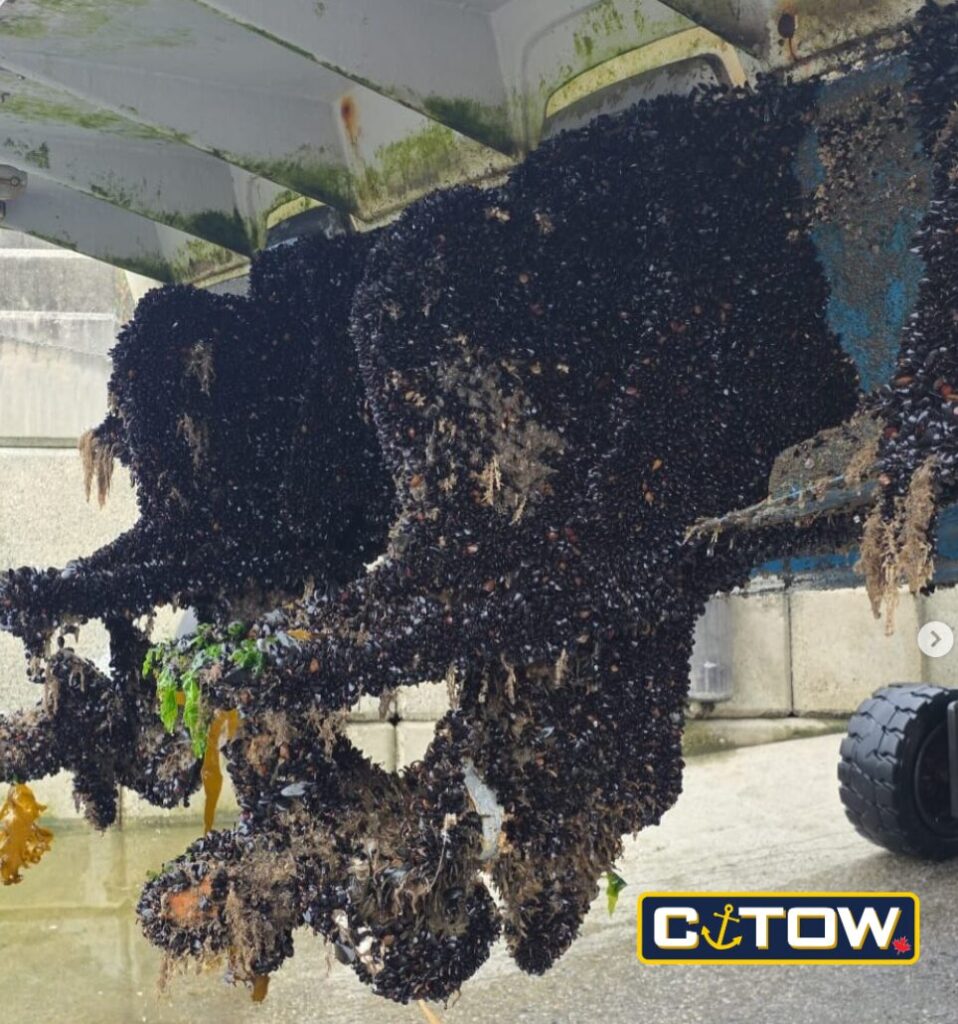
If you leave your boat in the water for any length of time through the warmer months, something is almost certainly growing on it. Zebra mussels, quagga mussels, barnacles, and algae don’t discriminate — they colonize every hard surface below the waterline, and your propeller and lower unit are prime real estate.
The results can be dramatic. A propeller and lower unit encrusted in thick layers of mussels and barnacles doesn’t just look bad — it fundamentally changes the hydrodynamic profile of every component it covers. Drag increases sharply. The blades lose their designed pitch and bite. What was once a cleanly spinning prop becomes something closer to a rough, irregular paddle wheel.
What to do:
- Inspect the lower unit every time you haul the boat out, even briefly.
- Remove growth by hand or with a plastic scraper while it’s fresh — it becomes significantly harder to remove once it calcifies.
- For boats kept in the water seasonally, apply a quality antifouling paint or coating rated for props and running gear before launch. Make sure the product you choose is compatible with your prop’s material (most modern antifouling paints are not suitable for bare aluminum without a primer).
- In areas with known invasive mussel pressure, consider a sacrificial zinc and regular haul-outs to keep growth under control.
- If growth is severe enough that you can’t fully remove it without risk of damaging the blades, have a marine professional clean and inspect the prop before you run it again.
Wrapped Up: Weeds, Fishing Line, and Debris Entanglement
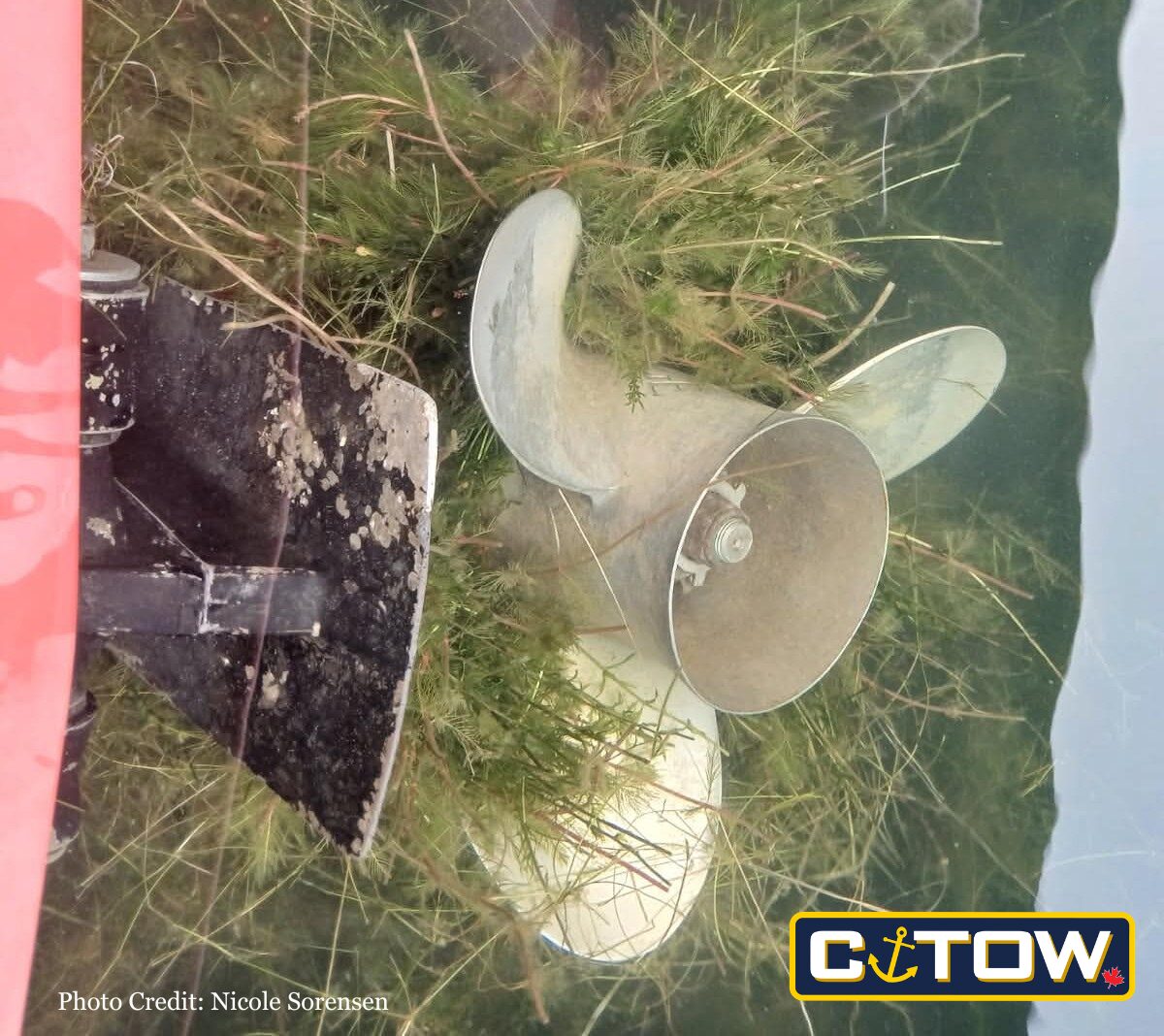
One look at a propeller shaft tangled in thick aquatic vegetation tells you everything you need to know about how quickly this problem develops. A single pass through a weed bed at reduced speed can wind a remarkable amount of material around your prop shaft — and what starts as a minor drag issue can escalate fast.
Fishing line is especially insidious. It’s nearly invisible in the water, strong enough to resist prop wash, and wraps tightly into the shaft seal — which is exactly where you don’t want it. A single length of monofilament, left long enough, can work its way past the seal and damage the lower unit shaft bearing.
What to do:
- Slow down when navigating weedy or debris-heavy areas. At lower speeds, material is less likely to wind and bind.
- If you feel a change in vibration or resistance, shut down the engine and check before continuing.
- To remove wrapped weeds, shift to neutral and carefully reach below the surface to pull material clear by hand, working in the direction it wound. Never put your hands near the prop with the engine running — not even at idle.
- For fishing line, use a sharp knife to cut it away in sections. Do not attempt to pull it out forcefully if it’s worked into the shaft seal area; that’s a job for a mechanic.
- After any entanglement incident, inspect the prop blades for nicks or bending, and check that the lower unit is not leaking gear oil (a sign the seal has been compromised).
Cavitation and Ventilation
These two terms are often used interchangeably but describe different problems — both of which are more common in summer when boats are running hard.
Ventilation happens when air from the surface (or exhaust gases from the lower unit) is drawn into the prop blades, causing them to lose grip and the engine to over-rev. It often happens in sharp turns, when the motor is trimmed too high, or when operating in rough water.
Cavitation is different — it occurs when the pressure on the back face of a blade drops low enough to vaporize the water itself, creating microscopic bubbles that collapse violently against the blade surface. Over time, cavitation literally erodes metal. A pitted, rough blade face is often the result.
What to do:
- Adjust trim angle to keep the prop properly loaded, especially at speed.
- Have a qualified marine technician check that the prop diameter, pitch, and rotation are correctly matched to your engine and hull — improper spec is a common cause of chronic cavitation.
- Inspect blades regularly for small pits or erosion on the low-pressure face. If you see it, have the prop professionally serviced before the damage progresses.
Dings, Nicks, and Bent Blades
Rocks, sandbars, floating debris, submerged docks — Canadian lakes and rivers have plenty of hazards lurking just below the surface, and even a minor strike can bend a blade or leave a chip in the leading edge.
Small nicks might seem like a cosmetic issue, but they’re not. A chipped or bent blade creates an imbalance that shows up as vibration — and vibration is transmitted directly through the lower unit and into the engine mounts. Run a damaged prop long enough and you’re looking at premature bearing wear, seal failure, and potentially a cracked gearcase.
What to do:
- After any strike — grounding, hitting debris, contact with a dock — pull the boat out and inspect the prop before continuing.
- Small nicks on blade edges can sometimes be smoothed with a fine metal file, but any significant bending, cracking, or cupping is a job for a prop shop. Precision prop reconditioning involves hydraulic straightening and blade pitch balancing that simply can’t be replicated in a driveway.
- Keep a spare prop on board if your boating takes you to remote areas. It can be the difference between getting home and waiting for a tow.
Corrosion and Electrolysis
Aluminum props are vulnerable to galvanic corrosion, especially in marina environments where stray electrical current in the water accelerates the process dramatically. You may notice pitting, chalky white oxidation, or — in severe cases — soft, deeply eroded areas on the blade surfaces.
What to do:
- Ensure your sacrificial zincs (or magnesium anodes in freshwater) are correctly sized and properly bonded. Replace them when they’re 50% depleted — not when they’re completely gone.
- If your boat is on shore power at a marina, make sure your galvanic isolator is functioning.
- Rinse your prop and lower unit with fresh water after every outing in salt water or brackish conditions.
- Inspect anodes at every haul-out, not just at the end of the season.
Spun Hub
The rubber hub insert inside your prop is a torque buffer — it’s designed to absorb shock loads so that impact damage goes to the hub rather than the gearcase. When the hub spins, it means that insert has failed, and the engine revs freely without the prop actually turning (or turns inconsistently).
Spun hubs often happen after a strike, but they can also occur gradually through wear. The symptom is an engine that over-revs but produces little thrust, or that feels like it’s slipping under load.
This is not a driveway fix. A spun hub requires removing the prop and having the insert pressed out and replaced professionally.
Building a Simple Inspection Routine
You don’t need to haul the boat every week, but a brief end-of-outing check costs you almost nothing and catches most problems early:
- Visual check every time the boat comes out of the water. Look for obvious fouling, debris wrap, dings, or anything that wasn’t there before.
- Spin the prop by hand (engine off, key out, ignition off) before and after runs. It should feel smooth and consistent. Any roughness, wobbling, or hard spots warrants a closer look.
- Check for gear oil leakage around the shaft seal after removing any entanglement. A few drops of milky or dark oil on the lower unit is a warning sign.
- Full seasonal inspection at haul-out. Remove the prop, inspect the shaft, replace the thrust washer and cotter pin, repack or inspect the hub, and assess blade condition carefully.
Off-Season Storage
When the season ends, take a few minutes to set your prop up for spring:
- Remove the prop, clean it thoroughly, and inspect it with good lighting.
- Apply a light coat of corrosion inhibitor or waterproof grease to the shaft splines.
- Store the prop somewhere it won’t be knocked around and have blades damaged in storage.
- Address any repairs before the spring — prop shops are busy from May onward, and you don’t want to be waiting for a reconditioned prop when the ice finally goes out.
When Things Go Wrong Anyway
Even well-maintained props fail. A submerged hazard you couldn’t see, a weed bed at the wrong moment, a line you didn’t notice — sometimes the water wins.
That’s where a C-Tow membership earns its keep. Whether your prop is wrapped, your hub has spun, or you’ve taken on damage that makes the boat unsafe to operate, C-Tow’s captains are available 24/7 across Canadian waters to bring you in safely. With over 40 years on the water and the largest towing fleet in Canada, we’ve seen every prop situation imaginable — and we’re there when yours happens.
Stay on top of your prop, and you’ll spend far more time enjoying the summer than dealing with it. But if the unexpected happens, we’ve got you covered.
Learn more about C-Tow membership at c-tow.ca.