 JOIN
JOIN MEMBERS
 C-TOW APP
 CAREERS
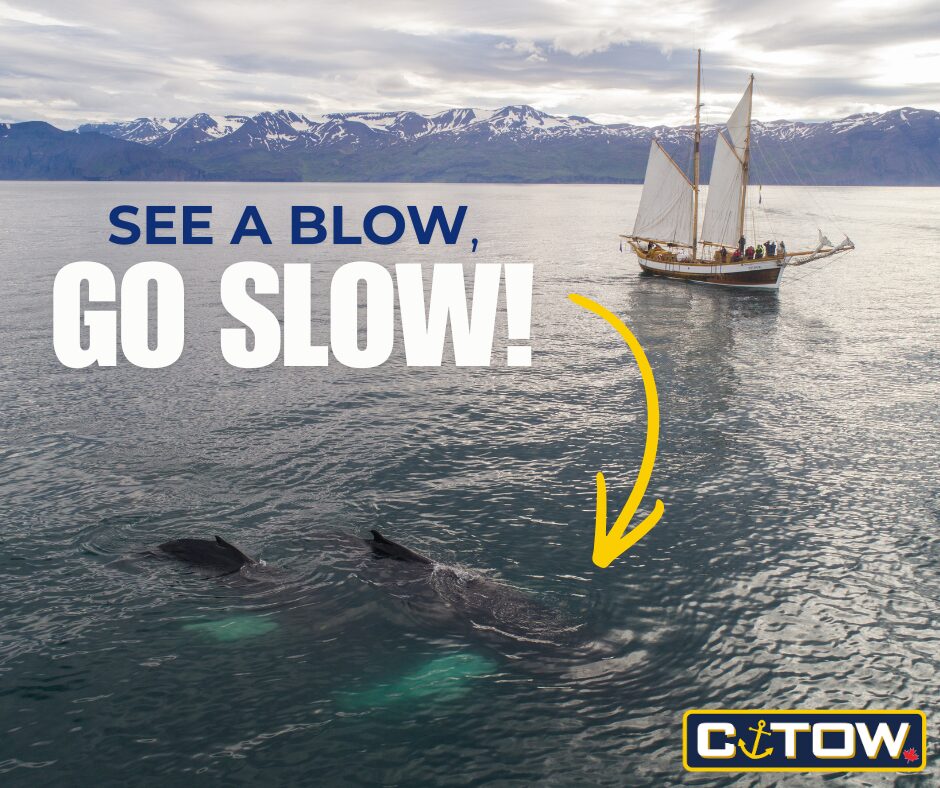
There’s nothing quite like the moment a whale surfaces beside your boat — that ancient, breathtaking presence breaking the waterline, close enough to hear the exhale. For many boaters, it’s the most memorable experience on the water. But that proximity cuts both ways. Marine mammals across Canada’s coastlines and inland waterways face real, ongoing threats from recreational and commercial boating — and as the people who know and love these waters best, boaters are in a uniquely powerful position to make a difference.
This guide covers what to watch for, what the law requires, and what good seamanship looks like when it comes to protecting the marine life we share the water with.
Recognizing the Signs: Indicators of Marine Mammal Presence
The first step in avoiding a collision or disturbance is knowing what to look for. Marine mammals are often nearby long before they’re visible, and a skilled boater learns to read the water.
Visual cues to watch for:
- Blows and spouts — The misty puff of a whale or dolphin exhaling is often the first sign. It can appear as a faint column of vapour, especially in calm conditions.
- Fluke and fin sightings — Tails, dorsal fins, and flukes breaking the surface, even briefly, signal animals in the area.
- Boils and surface disturbances — A flat, oily “footprint” on the water’s surface is often left by a whale just below. Circular disturbances in the water can indicate a feeding or resting mammal.
- Seabird activity — Concentrations of diving seabirds often indicate baitfish near the surface — and where there’s baitfish, there are often marine mammals feeding below.
- Floating debris and foam — Feeding activity can churn up foam, oil slicks from krill, and other debris. Proceed with caution in these zones.
- Other vessel behaviour — If nearby boats are slowing, stopping, or altering course, it may be because they’ve spotted marine life. Follow their lead.
Minimizing collision risk:
- Reduce speed in known marine mammal habitats, especially during migration periods.
- Post a dedicated lookout when transiting areas with documented sightings.
- Avoid operating at high speed in low-visibility conditions (fog, rain, dusk) in coastal or open-water environments.
- Keep engine noise steady — sudden throttle changes can startle animals that have surfaced to breathe.
- If a marine mammal is spotted ahead, reduce speed immediately and alter course gradually — not sharply — to give the animal space to move away naturally.
Know the Law: Legal Protections for Marine Mammals
Canada takes marine mammal protection seriously, and ignorance of the law is not a defence on the water. Several pieces of federal legislation govern how boaters must behave around marine mammals.
The Marine Mammal Regulations (under the Fisheries Act)
These regulations establish minimum approach distances for marine mammals across Canada. While specific distances vary by species and region, the general framework prohibits:
- Disturbing, disrupting, or killing a marine mammal
- Approaching within a set distance (varies by species — see below)
- Feeding marine mammals in the wild
- Operating a vessel in a manner that disturbs or displaces an animal
Key approach distances under current regulations:
| Species | Minimum Distance |
| Killer whales (orca) in British Columbia | 1000 metres (in designated zones as of June 1 2026); 200 metres elsewhere |
| All other cetaceans (whales, dolphins, porpoises) | 100 metres |
| Pinnipeds (seals, sea lions) on shore/ice | 100 metres |
| Steller sea lions (non-rookery) | 100 metres |
Note: Local Notices to Mariners and Transport Canada advisories may impose additional restrictions in specific areas. Always check current advisories before heading out.
The Species at Risk Act (SARA)
SARA provides additional protection for species listed as endangered, threatened, or of special concern — including species like the North Atlantic right whale, St. Lawrence Estuary beluga, and Southern Resident killer whale. Under SARA, it is an offence to harm, harass, or kill a listed species or destroy critical habitat.
For boaters, this means:
- Speed restrictions may apply in certain critical habitats (particularly for North Atlantic right whales in the Gulf of St. Lawrence).
- Dynamic Management Areas (DMAs) can be activated on short notice when at-risk species are detected. These may require vessels to slow to 10 knots or less.
- Entanglement in fishing gear is a leading cause of right whale mortality — modified fishing practices in these areas are not optional.
Why These Laws Exist
Marine mammals face compounding pressures: climate-driven prey shifts, pollution, entanglement in fishing gear, and chronic disturbance from vessel traffic. Even when an encounter doesn’t end in a direct collision, repeated vessel disturbance can:
- Interrupt feeding behaviour, causing animals to leave critical foraging habitat
- Separate mothers from calves
- Force animals to alter migration routes, increasing energy expenditure
- Cause acoustic masking — vessels are loud underwater, and many marine mammals rely on sound for navigation, communication, and finding food
- Elevate stress hormones, compromising immune function and reproduction over time
These aren’t abstract concerns. Several Canadian whale populations are critically endangered, in part because of cumulative, long-term human disturbance. The laws exist because voluntary compliance, historically, hasn’t been enough.
Best Practices on the Water
Legal compliance sets the floor — good seamanship goes further. Here’s how boaters can minimize their impact even beyond what the law requires.
Around Fishing Gear
- Use weak links and sinking groundlines where possible to reduce entanglement risk if gear is encountered by a whale.
- Mark your gear clearly and retrieve it promptly — abandoned or lost gear (ghost gear) is one of the most dangerous threats to large whales.
- If you encounter an entangled animal, do not attempt to free it yourself. An entangled whale is unpredictable and dangerous. Report it immediately (see reporting section below) and keep other vessels clear of the area.
- Avoid deploying gear in areas where marine mammal activity has been observed.
Reducing Noise Impact
- Slow down. Propeller cavitation is a major source of underwater noise — reducing speed dramatically reduces acoustic disturbance.
- Avoid idling engines unnecessarily when marine mammals are nearby.
- Do not use underwater sonar equipment or fish finders at high power settings when animals are in proximity.
- If anchored and animals approach, consider shutting down engines entirely to minimize noise.
Social Media — Share Responsibly
We get it. A whale surfacing twenty feet from your boat is incredible, and the instinct to grab your phone is human. But how you document and share that moment matters.
Do:
- Keep filming from a stationary or slow-moving vessel.
- Note the GPS coordinates, time, and species if possible — this data is genuinely valuable for researchers.
- Share with local marine wildlife organizations or citizen science platforms along with your post.
- Use your platform to educate — caption your post with a note about approach distances or report lines.
Don’t:
- Chase an animal for a better angle or to keep it in frame.
- Post locations in real time in a way that could attract a crowd of vessels to a resting or feeding animal.
- Geotag sensitive haul-out sites or denning areas where pinnipeds are resting.
- Use drone footage taken closer than permitted distances — regulations on drones around marine mammals are increasingly enforced.
Alerting Other Boaters
You are your fellow boater’s best early warning system. If you spot marine mammals in the area:
- Communicate on VHF Channel 16 (the distress and calling channel) to alert nearby vessels: “Security, Security, Security — [your vessel name] at [position], whale(s) sighted in the area, all vessels proceed with caution.”
- Use hand signals or horn signals if vessels are close enough.
- Report to the Coast Guard if animals appear to be in a high-traffic area where collision risk is elevated.
- If you’re part of a marina community or boating club, share sighting information through your club channels so members can plan accordingly.
The Value of Reporting
Reporting is one of the most impactful things a boater can do — and it’s consistently underutilized. Every sighting, every incident, and every violation report contributes to a larger picture that researchers, enforcement officers, and conservation managers rely on to protect marine life.
Sightings
Whale and marine mammal sighting data is used to:
- Track population movement and seasonal distribution
- Identify critical feeding, calving, and migratory habitat
- Inform Dynamic Management Area decisions (i.e., where speed restrictions get activated)
- Assess population health and recovery trends for endangered species
You don’t need to be a biologist to contribute valuable data. A GPS position, a time stamp, an estimated count, and a species description (even a photo) can all be useful. Many citizen science platforms make this straightforward — see the resources section below.
Violations of the Laws
If you witness another vessel violating approach distances, chasing marine mammals, or otherwise acting in a way that constitutes harassment or harm, you can and should report it. Document as much as possible:
- Date, time, and location (GPS coordinates if available)
- Description of the vessel (name, registration number, colour, size, type)
- Description of the behaviour observed
- Names and contact information of any witnesses
- Photographs or video if safely obtainable
Reports can be made to Fisheries and Oceans Canada (DFO) or the Canadian Coast Guard. Violations under the Fisheries Act and SARA can result in significant fines and, in serious cases, criminal charges.
Dead, Injured, or Distressed Marine Mammals
A stranded, entangled, or deceased marine animal is both an emergency and a scientific opportunity. Necropsies (animal autopsies) on dead whales, for example, provide invaluable data on cause of death, health status, and the presence of toxins or pathogens.
If you encounter a dead, injured, or distressed marine mammal:
- Do not approach or touch the animal.
- Note your position (GPS), the species if identifiable, the condition of the animal, and any markings or tags.
- Call the Canadian Coast Guard immediately on VHF Channel 16 or by phone.
- Contact the Marine Mammal Incident Reporting hotline for your region (see below).
- If the animal is alive and in distress (entangled, stranded on shore), keep people and pets away and wait for trained responders. Well-meaning intervention can cause additional injury.
Downloadable Resources and Reporting Contacts
Where to Report Sightings
| Resource | Contact / Link |
| WhaleReport Alert System (WRAS) — BC Coast | Via the WhaleReport app (iOS/Android) — real-time alerts for mariners |
| Fisheries and Oceans Canada (DFO) Sighting Reports | 1-800-465-4336 (Pacific) / 1-800-668-6767 (Atlantic) |
| NOAA Whale Alert App (for US border waters) | Available on iOS and Android |
| OrcaSound Citizen Science Network | Via orcasound.net |
| iNaturalist | iNaturalist.ca — log sightings of any wildlife, including marine mammals |
Reporting Violations and Incidents
| Resource | Contact |
| DFO Enforcement — Fisheries Violations | 1-800-565-1633 (Atlantic) / 1-800-465-4336 (Pacific) |
| Canadian Coast Guard — Emergencies | VHF Channel 16 / 1-800-267-6687 |
| Report-A-Poacher (Ontario) | 1-877-847-7667 |
| Environment and Climate Change Canada Tip Line | 1-800-668-6767 |
Dead, Injured, or Distressed Marine Mammal Response
| Resource | Contact |
| Marine Animal Response Society (MARS) — Atlantic | 1-866-567-6277 |
| BC Cetacean Sightings Network | 1-800-665-5939 or report online at wildwhales.org |
| Pacific Marine Life Surveys | Via Facebook: Pacific Marine Life Surveys |
| Canadian Coast Guard | VHF Channel 16 (always first call in emergencies) |
Forms and Field Guides
- Violation/Incident Note-Taking Template (print and keep onboard): Record vessel description, behaviour, GPS position, time, date, and witness information. Templates are available through DFO’s Pacific and Atlantic regional offices, or ask your marina to keep printed copies at the dock.
- Species Identification Cards: Laminated waterproof ID cards for common marine mammals are available through Fisheries and Oceans Canada and many provincial marine organizations.
- Transport Canada’s Small Vessel Operator Guide: Includes regulations around marine mammal interactions and can be downloaded at tc.gc.ca.
A Final Word from C-Tow
For over 40 years, C-Tow has been on the water alongside Canadian boaters — through emergencies, through storms, and through the everyday joy of a day out on the lake or the sea. We’ve seen firsthand how much our members care about these environments.
The whales, seals, dolphins, and porpoises that share our waterways are not obstacles — they’re indicators of the health of the ecosystems we depend on and love. Keeping them safe is part of being a responsible, skilled mariner.
Slow down. Keep your distance. Report what you see. And share this information with the boaters around you — because the best tool we have for protecting marine life is a community that knows better and does better.
C-Tow Marine Assistance — Canada’s largest marine towing fleet, serving boaters since 1984.24/7 Emergency Line: 1-888-419-2869 | www.c-tow.ca