 JOIN
JOIN MEMBERS
 C-TOW APP
 CAREERS
Our dinghy is our vehicle that transports us from our sailboat to shore and takes us on all our adventures. Without it we are stranded onboard with no connection to shore while cruising around the Caribbean. If our outboard engine starts to give us trouble then repairing it quickly goes to the top of our to do list.
Keeping close attention to how your engine is running gives you a good baseline to catch problems before they get too bad. If anything changes you know it has to do with something recent (bad fuel, clogged jet, stuck choke). The sounds of your engine while running at idle or while trying to start, how much water flows out the back and how hot it is for example may give you some idea of what is happening inside before you start taking things apart.
This gives you a place to start your inspection. Keep track of anything you take apart with pictures as they can save you down the road for reassembly. If you are unsure of the problem then try to only change one thing at a time to help isolate where your problem is coming from.
Does it sound like it normally does when you pull on the cord? If not, double check your kill cord (it’s embarrassing but we have all forgotten to put it in before). Does it sound like it’s getting fuel? When the carburetor is empty and you put the cord the engine sounds different. Same thing for if your choke is on or not. They are subtle changes in sound but when you have started your engine hundreds of times you can feel something is off.
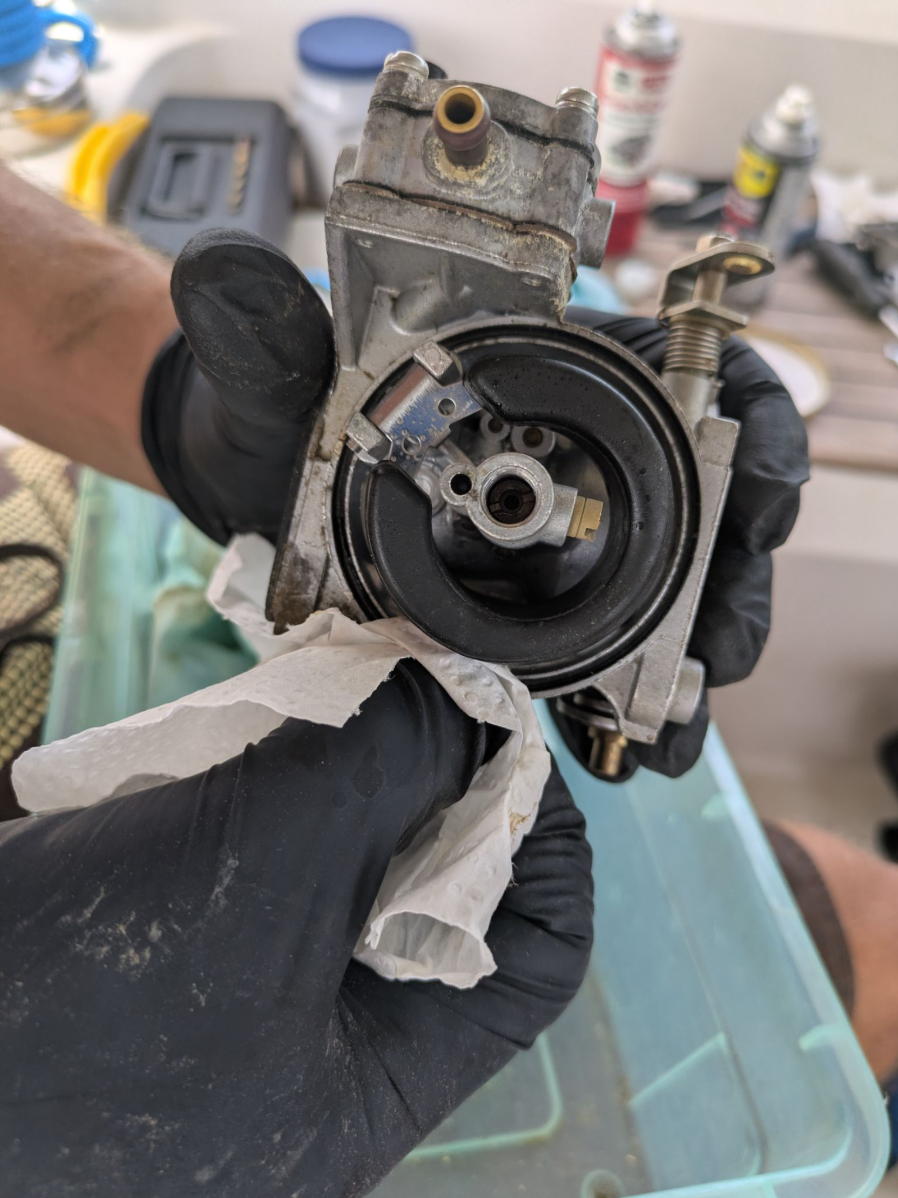
In our case our outboard just decided it would not start one day after running so well for so long. It seemed strange but in this case it was obvious where part of the problem was. When pulling on the choke it was stiff. When I took the lid off I could see that pulling on the choke did nothing on the carburetor. The flap was stuck shut so when I was trying to start it was choked and couldn’t get air to mix with the fuel. Since it had been a while since my last cleaning of the carburetor I decided to take it apart and give it some TLC. After changing out the rusty sparkplugs before they fall apart and putting on a new fuel filter I gave the carb my attention. Using carb cleaner, an old toothbrush, and rag I got rid of a lot of the gummy varnish that builds up from ethanol fuel (not many choices for ethanol free in the islands). After I had given it a good spray and got the choke working again with some WD-40 I put it back together and tested it out. It finally starts but refuses to run at idle. It runs fine at higher rpms but seems to cough and die out as soon as the rpm drops. Back to the drawing board.
I figured I needed to clean things a little better so it all came apart again including the jets (needle jet and needle valve) so I could be more thorough about my cleaning. Fortunately it seems to run better after this but still stalls from time to time. Just running the engine at higher rpms has seemed to clear out whatever I missed and it now runs fine at idle.
Just yesterday while motoring to the Carnival here in Grenada I felt the water coming off the engine and it seems to be running hotter than before (based on my previous baseline hand temp check). This makes me think I need to check my impeller and maybe try a flush but it could also be the heat wave and higher water temps we are having. Still keeping an eye, ear and feel for differences in your outboard may help keep you out of trouble and exploring without as much outboard anxiety.
Cory Bertrand
Cory and Alex share their adventure with weekly videos on their YouTube channel “Wildly Intrepid Sailing”. Their dream is to travel the world and to live without any regrets.