 JOIN
JOIN MEMBERS
 C-TOW APP
 CAREERS
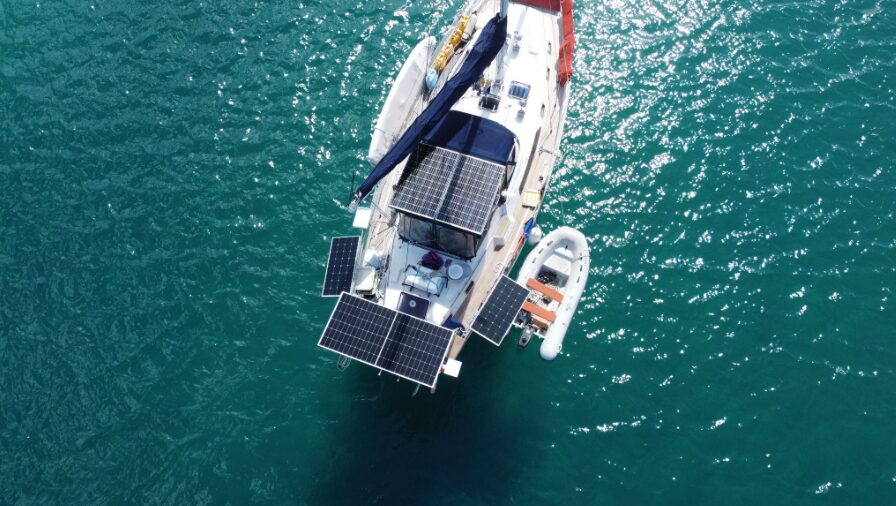
Installing more solar has been a common job onboard both of our boats over the years. Solar is the backbone of our electrical system. Without it we would need to run generators or the engine for hours everyday. The problem is on a monohull, space is very limited and options on where to mount more solar can be tricky. There is a limit to how much solar you can realistically fit onboard
This season cruising the Caribbean we started to think we really could use more solar as every few days we found ourselves having to run the generator, even with nice sunny days. After some testing we realized some of our old panels were not outputting. One was an easy fix as the MC4 connector had gotten water inside and was completely corroded. This leads to very low output or none at all. Another panel had just stopped altogether, no voltage and no current.
This was one of our semi flexible panels and after inspection the positive wire had corroded under the junction box mounted to the panel. After 5 panels have failed to output around the 1 year mark we have completely ruled out using semi flexible panels ever again on our sailboat. This limits our options even more when it comes to adding more solar but from our experience the semi flexible panels don’t live up to their marketing.
Of course we could look into installing a wind turbine but we don’t like the noise and maintenance required to keep them running. With dropping solar prices, if you can find the space for more solar it is much more affordable than other options per Watt even if you need to fabricate a support for it.
So with limited space and our minds made up on getting more rigid panels we had some planning to do. So out came the measuring tape and we started thinking about where we could add more panels. The problem is we already had quite a lot of solar onboard. 600w on our arch, 400w on our aft lifelines and 200w semi flexible on our dodger.
After measuring and planning I figured I could get away with more panels on our arch but would need to make some modifications and add some aluminum to make it work. We had some panels we could buy locally in St Martin but the sizes were not what I was hoping for. A few smaller panels and a lot of very large panels. Since I was adding to the arch I liked the idea of getting a bifacial panel (solar cells on both sides of the panel) as I have heard the output tends to be over what the panel is rated for. The only problem was the only bifacial I could find was 600w. Which is very large at … From my measurements I could make it work by moving the existing 300w panels forward on the arch and hanging the 600w behind that.
After drawing out a plan on how I was going to support this large array on a smallish arch it all seemed like it was going to work on paper… So I picked up some angled aluminum, some brazing rods and the massive panel and got to work. I quickly realized my plans only worked on paper and would be way too big of an array balancing on our arch even with my planned supports. So back to the drawing board and tape measure to figure out where I could mount the monster. The issue with such a big panel is it needs more support than my 2 300w panels. It is so big it actually flexes and bows in the center of the panel. This panel was just too cheap (USD $379) to pass up and I figured “I’ll make it work” as it was almost half the price of the other panels I sourced.
I knew I wanted the new panel to be mounted on the arch to capture the light reflected off the water taking advantage of the bifacial. So I decided the 2 300w panels would have to go on the Bimini to make room for the 600w on the arch. The only issue was the 600w needed to be supported and secured differently as the dimensions didn’t allow me to use the existing t bolts holding down the 300s on the extruded aluminum.
So I started cutting the aluminum and attempted to braze the parts together to make a frame for the 600w. Brazing aluminum is much like soldering copper pipes together. You heat up the metal to over 700 degrees which is under the melting point of aluminum but above the melting point of the filler brazing rod. Then you touch the rod against the heated aluminum which welds the metals together. If you get the metal hot enough you have a joint just as strong as a weld. The problem I had was being on anchor and the wind blowing above 20 knots made it nearly impossible to get the metal hot enough with my propane torch. Also making such a big frame onboard was difficult as I had very limited room to work as well as the work surface was not level. So I spent more time moving wood around to support my frame and keep things lined up. Unlike welding you can’t just tack things into place and then weld it up to make it stronger. As you heat the metal it needs to be exactly where you want it and clamped down so it doesn’t move until the metal cools off. With these challenges I think it would have been better to weld everything but sometimes you just do what you have to do. Since I didn’t trust the welds I drilled and installed backup rivets where I could in case the welds failed underway.
After the frame was made I figured out a few ways of mounting it to the arch. Finally I settled on using through bolts to the old t nuts which fit in the existing extruded aluminum on the arch. Secured the panel with self tapping screws to the installed frame. One down and 2 more panels to go. Seeing peak output of 700w on a 600w panel made me happy with my decision to make the big panel work.
The other panels did not need as much support but since I had the material I decided to build a frame for them as well but the challenge was how to mount it to the existing Bimini. I decided to burn holes through the canvas with a heated screwdriver and put bolts to support the panel frame to the Bimini frame. This took some trial and error but eventually I found something that works. We have a canvas Bimini without a lot of support so when I did get the panels up I quickly realized the added weight meant I needed some more support from side to side. So for now we tied some lines in a X to support the Bimini while we do some sea trails with our new setup. Between boom clearance being tight between the panels and boom and extra supports needed we want to be sure it’s all going to work before finalizing the install. As I write this we are sailing hard on the wind to Martinique and it seems to be holding so far.
Sometimes a boat project is more planning and replanning and adjusting those plans as things don’t work out. With enough persistence eventually you can find a solution and make it work.
Cory Bertrand
Cory and Alex share their adventure with weekly videos on their YouTube channel “Wildly Intrepid Sailing”. Their dream is to travel the world and to live without any regrets.